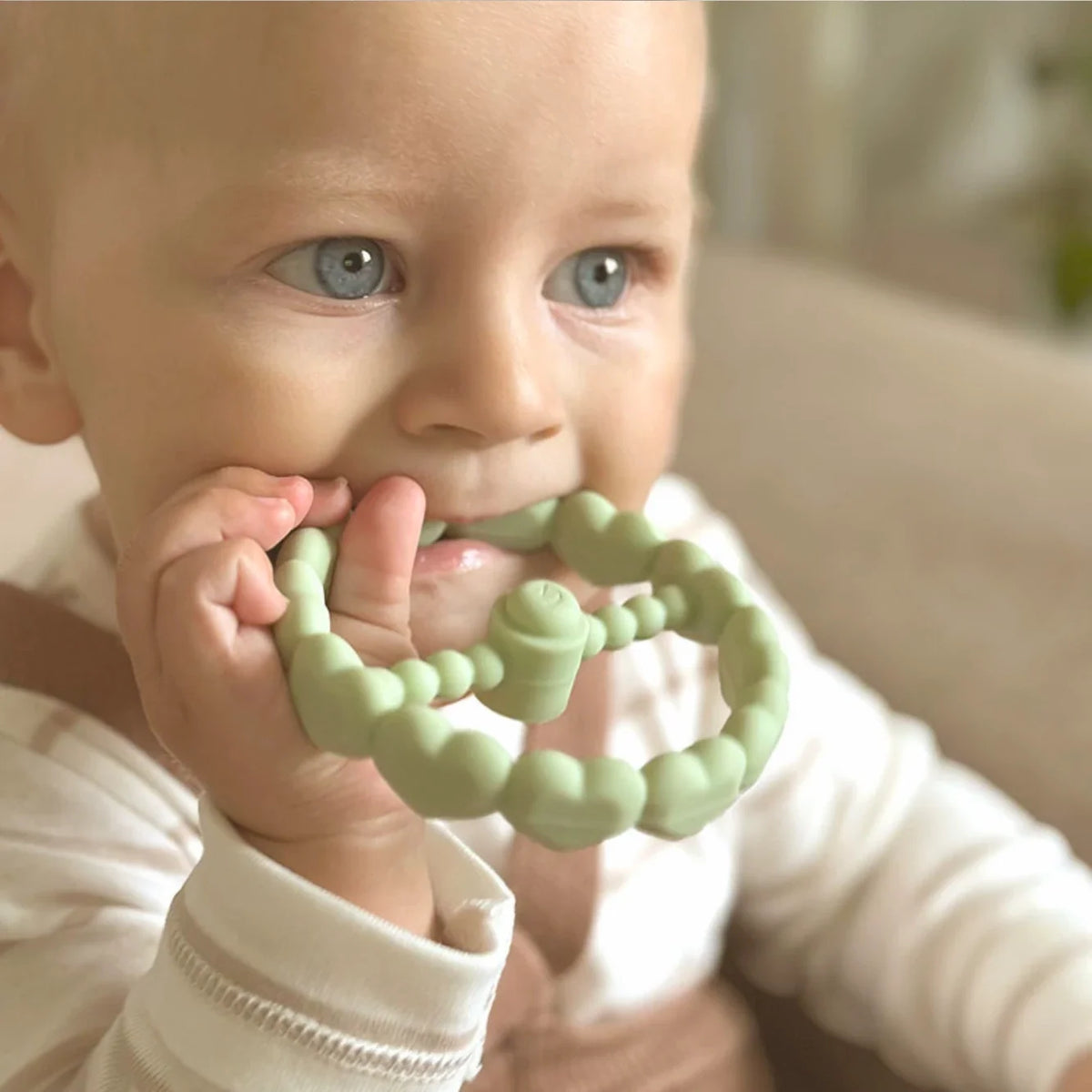


It's four in the afternoon. Your baby's cheeks are rosy, the bib is soaked, and everything within reach has gone straight into their mouth. You're wondering: is this teething?
Most babies cut their earliest tooth between 6 and 10 months, and some don't have one until after 12 months. Teething discomfort can begin as early as 3 months, well before anything shows. Teeth don't read the calendar. Your baby's timeline is their own.
Here's what usually happens, month by month, which teeth tend to arrive in which order, and when a call to your pediatrician is a good idea.
Teething at a Glance
Typical age for the earliest tooth: between 6 and 10 months
Teething signs can begin: from about 3 months, often well before a tooth shows
Usually the opening act: the two bottom front teeth
The full set: 20 baby teeth, usually all in by about age 3
Tooth running late? Some babies wait until after 12 months. Your pediatrician or dentist can take a look.
Teething by Age: What to Expect
These are general ranges based on the American Dental Association (ADA) and the American Academy of Pediatrics (AAP). Your baby may arrive a few weeks, or even a few months, ahead of or behind them. Take what helps. Leave the rest.
Age |
What's happening |
Teeth you might see |
0-3 months |
Fists, toys, and fingers head to the mouth, and drooling often picks up. This is usually your baby discovering their hands and mouth, not a tooth on the way. |
None yet |
3-4 months |
Some babies show teething signs this early: drool, chewing, extra fussiness. A tooth is usually still a few months away. |
None yet, for most babies |
6-10 months |
The most common window for the earliest tooth to break through. |
Bottom front teeth (central incisors) |
8-12 months |
The top front teeth make their entrance. |
Top front teeth, at about 8-12 months |
9-16 months |
Teeth appear on either side of the front teeth. |
Lateral incisors, at about 9-16 months |
13-19 months |
The back teeth begin to arrive. |
First molars, at about 13-19 months |
16-23 months |
The pointy ones show up. |
Canines, at about 16-23 months |
23-33 months |
The last baby teeth arrive at the very back. |
Second molars, at about 23-33 months |
Want something to stick on the fridge? Our baby teeth chart is a free printable you can use to jot down each arrival.
Teething at 3 Months and 4 Months
If your 3-month-old is drooling like a leaky tap, gnawing on their fist, and fussier than usual, teething is a fair guess. Some babies do show teething signs at this age. A tooth usually doesn't appear until somewhere between 6 and 10 months, though, so there may be a wait.
Drooling and chewing can also simply be development. Around 3 and 4 months, babies discover their hands and start bringing everything to their mouths, with or without a tooth on the way.
The same goes for teething at 4 months. It may be teething, it may be curiosity, and it may be a bit of both. Either way, comfort helps: a clean teether, a cool washcloth to chew on, a cuddle.
If a fever, diarrhea, or hard-to-soothe crying joins in, teething probably isn't the whole story, and that's worth a call to your pediatrician. Our guide to is it teething or something else walks through those symptoms one by one.
The Teething Order: Which Teeth Come In When
Baby teeth tend to arrive from the front of the mouth to the back:
Bottom front teeth (central incisors)
Top front teeth
The teeth beside the front teeth (lateral incisors)
First molars, the flat back teeth
Canines, the pointy ones
Second molars, at the very back
Babies often get a few teeth at a time, and a different order isn't unusual. The baby teeth chart shows each tooth and its typical age range.
Signs Your Baby May Be Teething
Drooling more than usual
Chewing on fingers, toys, and stroller straps
Rubbing or tugging at the gums
Tender or swollen gums
A bit more fussiness than usual
Many babies show very few signs at all, and each tooth's discomfort usually passes in a few days. For a closer look, read Teething 101: signs, symptoms, and what actually helps.

When to Call Your Pediatrician
Teething can make a baby drooly, chewy, and a bit fussier. According to the AAP, teething doesn't cause a fever, diarrhea, a diaper rash, or crying beyond the usual fussiness. If any of those show up, something else may be going on. Our guide to is it teething or something else walks through fever, rash, and diarrhea one by one.
A call to your pediatrician is a good idea if:
Your baby has a fever. The AAP says a fever isn't a teething sign.
Your baby is under 3 months old with a temperature of 100.4°F (38°C) or higher. This one needs a call right away.
Your baby has diarrhea that lasts more than a day.
Your baby's crying is hard to soothe or lasts longer than usual.
Something just feels off. Trust that instinct, because you know your baby.
If there's no tooth by 12 months, bring it up at your baby's next checkup. Your pediatrician or a pediatric dentist can take a look.
What Can Help Sore Gums
A teething afternoon calls for comfort more than a fix. A few things pediatric guidance often points to:
A clean teether or damp washcloth, chilled in the fridge, to chew on (nothing frozen solid)
A rub on the gums with a clean finger
Extra cuddles and a change of scenery
A fresh bib and a soft cloth for the drool
A word with your pediatrician if the discomfort is rough: they can tell you whether a pain reliever such as acetaminophen makes sense, and the right dose
The AAP advises skipping numbing gels, homeopathic teething tablets and gels, liquid-filled teethers, and teething necklaces made of any material. We explain why in what pediatricians say about teething tablets, gels, and necklaces, and you'll find more ideas in teething remedies: ways to soothe a teething baby.
If you'd like a teether on hand, easy-to-grip silicone shaped for tiny hands, like our Alligator & Lamb Teethers, rinses clean and is ready for the next round.
For ideas by age and material, see our guide to teething toys by age and material, or browse our teething collection.


"Simple teether that baby loves holding onto. It’s nice for her gums. A great choice for small babies."
Once Teeth Arrive: Brushing and a Dental Visit
Brushing can begin as soon as a tooth appears. A soft infant toothbrush and a smear of fluoride toothpaste, about the size of a grain of rice, twice a day, is what the ADA recommends. Before any teeth, a clean damp cloth over the gums after feeds does the job. More in when to start brushing baby teeth.
The AAP and ADA suggest a dental visit by age 1, or within six months of the earliest tooth.
Frequently Asked Questions
When Do Babies Start Teething?
Most babies cut their earliest tooth between 6 and 10 months, usually one of the two bottom front teeth. Teething discomfort can begin as early as 3 months, and some babies don't have a tooth until after 12 months. Each baby follows their own timeline, so a few weeks either way is ordinary.
Can a Baby Start Teething at 3 Months?
Yes, some babies show teething signs from about 3 months, such as drooling, chewing, and extra fussiness. A tooth usually shows up months later, and the same signs can simply mean your baby is discovering their hands. If a fever or diarrhea appears, call your pediatrician.
Is It Teething at 4 Months?
It can be. Drooling and chewing at 4 months may be teething, may be your baby discovering their hands and mouth, or both. A tooth is likely still a few months away. A fever isn't a teething sign, according to the AAP, so call your pediatrician if one appears.
What Order Do Baby Teeth Come In?
Baby teeth usually arrive from front to back: bottom front teeth, top front teeth, the teeth beside them, first molars, canines, and finally second molars. Babies often get a few at a time, and the order can vary. All 20 are usually in by about age 3. The baby teeth chart shows each window.
What If My Baby Has No Teeth by 12 Months?
Some babies take longer, and a later start is common. Mention it at your baby's next checkup, and your pediatrician or a pediatric dentist can take a look. A dental visit is recommended by age 1 or within six months of the earliest tooth, whichever is sooner.
How Long Does Teething Last?
Each tooth tends to cause discomfort for just a few days when it breaks through. Overall, teething comes and goes from the earliest signs, as early as 3 months, until the second molars arrive at about 2 to 3 years old, when most children have all 20 baby teeth.
However the Timeline Unfolds
Whether the earliest tooth arrives at 6 months or 14, you're doing great. Keep the cool teether handy, keep the bibs coming, and hug the moments that matter.
Keep reading: Baby Teeth Chart: When Each Tooth Comes In (Free Printable) · Teething 101: Signs, Symptoms and What Actually Helps · Teething Remedies: Safe Ways to Soothe a Teething Baby
This article is for general information and isn't a substitute for advice from your pediatrician or dentist.